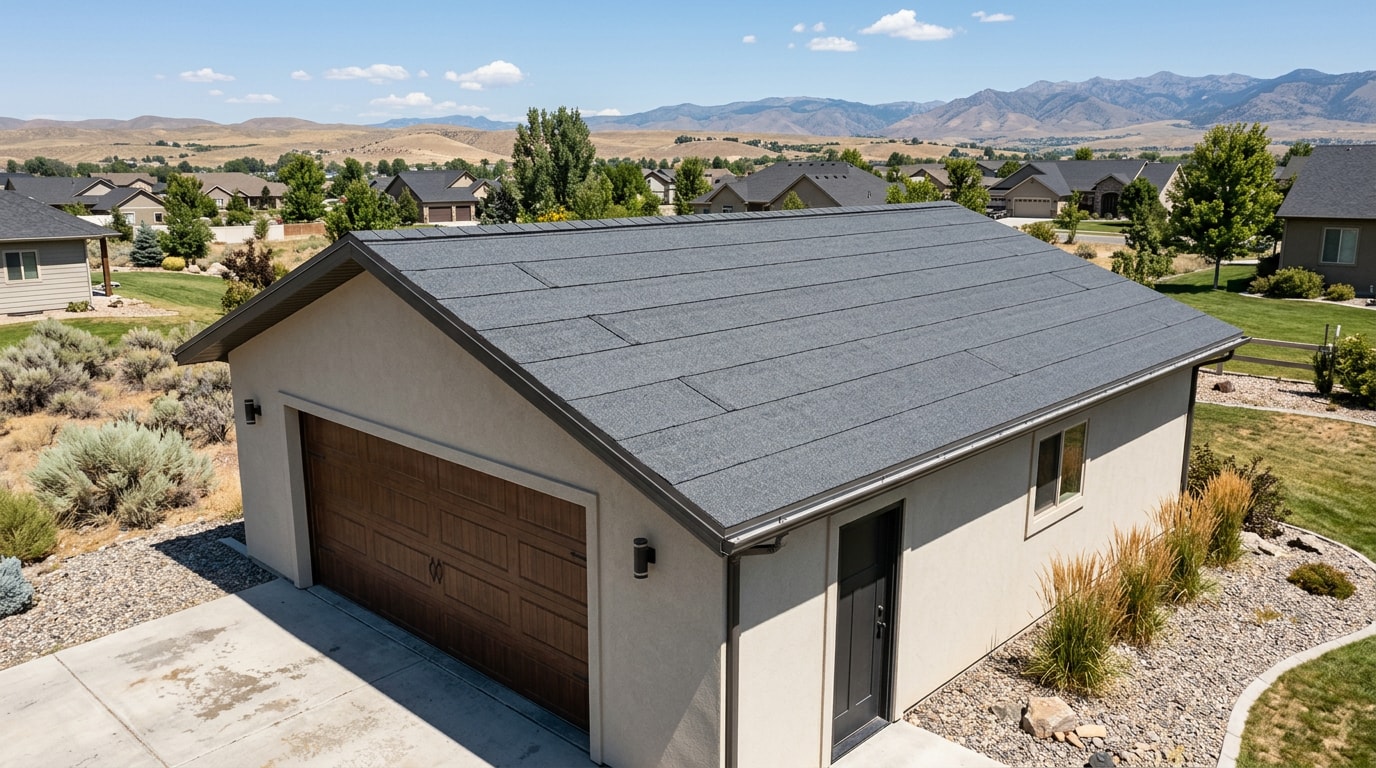
Roll roofing in Caldwell, ID is the fastest, lowest-cost way to protect a shed, detached garage, or low-slope addition from Treasure Valley weather. This guide breaks down real cost numbers, honest pros and cons, and the installation details that separate a roof that lasts fifteen years from one that fails in five. By the end, you'll know whether rolled asphalt is the right call for your structure, or whether it's worth stepping up to something longer-lived.
What Is Roll Roofing?
Roll roofing, also called rolled roofing or MSR roofing (mineral-surfaced roofing), is an asphalt-based membrane.
It's built from a fiberglass or felt mat saturated in asphalt and topped with mineral granules. Fiberglass shingles consist of a fiberglass mat, top and bottom layers of asphalt, and mineral granules , and roll roofing uses the same basic recipe in continuous sheets instead of individual tabs.
It ships in long rolls, typically 36 feet by 36 inches, covering roughly 100 square feet per roll. That makes it one of the fastest materials to lay down on a low-slope roof.
Because it comes in continuous sheets rather than individual pieces, it's best suited to simple structures rather than complex rooflines. You'll most often see it on sheds, detached garages, porch roofs, and other low-slope sections where steep-slope shingles aren't practical.

See where this material fits among our full lineup on the roofing contractor services page.
What Does Roll Roofing Cost in Caldwell, ID?
Roll roofing costs $2.00 to $5.50 per square foot installed, with material prices at $0.50 to $1.50 per square foot plus $1.50 to $4.50 per square foot for installation labor. Old roof removal adds $1 to $2 per square foot.
For whole-home projects, roll roofing costs $2.00 to $5.50 per square foot installed or $3,200 to $12,000 on average . Most Caldwell jobs we quote aren't whole-home projects, though. They're sheds, detached garages, and barn lean-tos under 500 square feet.
| Approach | Cost Per Sq Ft | What's Included |
|---|---|---|
| DIY, materials only | $0.50 – $1.50 | Roll roofing, fasteners, cement, no labor |
| Pro install, no tear-off | $2.00 – $3.50 | Labor and materials over an existing deck |
| Pro install with tear-off | $3.50 – $5.50+ | Old roofing removal, disposal, new install |
On a 200-square-foot shed roof, that works out to roughly $400 to $1,100 installed. A 400-square-foot garage runs closer to $800 to $2,200.
Want a number specific to your structure? Get a Free Estimate and we'll walk the roof before quoting anything.
What Affects the Cost?
- Roof size and accessibility. A steep driveway or a second-story garage roof adds time and risk, which shows up in labor pricing.
- Tear-off. Removing old material before installing new roll roofing adds disposal fees and labor hours compared to installing over an existing surface.
- Slope and pitch. Roll roofing is engineered for low-slope applications, and installers need to compensate on anything approaching a standard shingle pitch.
- Material grade. Basic MSR versus modified bitumen can shift the price per square foot by a dollar or more.
- Local wind exposure. Canyon County's seasonal wind events can lift poorly sealed edges faster than in calmer climates, which is a reason to not cut corners on cement at laps and edges.
Why National Cost Guides Don't Tell the Whole Caldwell Story
Most online roll-roofing guides are built around national whole-house price tags. That's useful context, but it's rarely the job homeowners here are actually pricing.
When our crews inspect older shed and garage roofs around Caldwell, lifted end-laps near the ridge are the single most common failure we find. It's usually wind catching a corner that was never fully set in cement, not the membrane itself wearing out.
That's also why the cheapest mineral-surfaced roll isn't automatically the better value. If you re-cover twice in ten years, a modified bitumen product that costs more upfront can pencil out cheaper per year of coverage.
Pros and Cons of Roll Roofing
Roll roofing is a trade-off between upfront savings and long-term durability. Here's where it earns its keep, and where it doesn't.
Pros
- Low cost. It qualifies as one of the cheapest roofing materials available, even with professional installation.
- Fast installation. Wide strips install far quicker than individual shingles, cutting labor time significantly.
- DIY-friendly. A handy homeowner can realistically tackle a simple, low-slope shed or small garage roof.
- Easy re-cover. When it wears out, the old layer can often serve as a base for the next one, cutting future tear-off costs.

Cons
- Shorter lifespan.
Asphalt roll roofing lasts between 5 and 10 years on average, though some may reach up to 15 years with good care. That's a shorter window than heavier materials.
- Limited style options. You won't find the color and texture variety that shingles or metal offer.
- Faster wear in harsh weather. Strong wind gusts and freeze-thaw swings common to the Treasure Valley can accelerate seam failure and granule loss.
- Not rated for a main house roof. It's a secondary-structure material, not a primary one.
Types of Rolled Roofing Materials
Most homeowners shopping for a rolled comp roof run into three general categories.
Standard mineral-surfaced roofing is the budget option, built for basic weather protection on sheds and outbuildings. Modified bitumen rolls add rubberized polymers for better flexibility and can reach 10 to 20 years when installed correctly and maintained , usually at a higher price point.
There are also smooth-surfaced and saturated-felt variants, which skip the granule topcoat and are often used as an underlayment or a torch-down base layer rather than a finished surface.
If you're weighing a premium rolled option for a larger flat section, our rubber roofing guide for Nampa homeowners covers EPDM membrane costs and performance in more depth.
How to Install Roll Roofing
Installation follows a specific sequence, whether you're hiring it out or doing it yourself.
- Prep the deck. Clean, dry, and free of old fasteners.
- Install drip edge along the eaves.
- Roll out underlayment if the manufacturer calls for it.
- Nail the first course along the low edge.
- Overlap each subsequent course by several inches, nailing as you go.
- Seal every overlap with roofing cement to prevent water intrusion.
- Finish ridges and hips with cap strips set in cement.
Temperature matters more than most DIYers expect. In cold weather, for easiest handling, temperatures should be above 40°F, and in hot weather, for easiest handling, temperatures should be below 90°F , according to GAF's technical guidance for asphalt roofing products. Timing an install during Canyon County's mild spring or fall windows pays off.
Safety gear matters too. Falls are the leading cause of work-related deaths among residential construction workers , so slip-resistant footwear and fall protection on anything above single-story height aren't optional extras.

If a full tear-off or replacement is on the table, our roof installation and roof replacement teams can handle it start to finish.
Roll Roofing Maintenance
Maintenance comes down to three habits:
- Inspect seams and flashing twice a year.
- Clear debris and gutters regularly.
- Patch small defects the moment you spot them.
Catching a lifted seam or a small puncture early is far cheaper than dealing with interior water damage later. Caldwell's farm-ground dust and freeze-thaw cycling both accelerate wear on exposed asphalt surfaces, so a seam check after a major wind event or a hard freeze is worth the ten minutes it takes.
If a small issue has already turned into a leak, our roof repair and roof inspection teams can catch it before it spreads. After a wind event, our storm damage repair crew can assess lifted edges the same week.
Rolled Roofing vs. Other Low-Slope Materials
Roll roofing isn't the only option for low-slope sections. Here's how it stacks up.
| Material | Typical Lifespan | Installed Cost Per Sq Ft |
|---|---|---|
| Asphalt roll roofing | 5–10 years (up to 15 with care) | $2.00 – $5.50 |
| Modified bitumen | 10–20 years |
$4.00 – $7.50
| TPO |
15–20 years
|
$4.00 – $10.00
| EPDM (rubber) |
20–25 years
|
$4.00 – $10.00
|
Roll roofing wins on upfront price and simplicity. Modified bitumen, TPO, and EPDM win on longevity and total cost of ownership over a 20-plus-year horizon. If your structure is a long-term investment rather than a short-term outbuilding, it's worth weighing those options before deciding.
FAQ
How long does roll roofing last?
Asphalt roll roofing lasts between 5 and 10 years on average, though some may reach up to 15 years with good care. Modified bitumen versions sit at the higher end of that range.
What's the difference between roll roofing and shingles?
Roll roofing uses continuous sheets installed in wide overlapping strips, while shingles are individual pieces layered one at a time. Shingles cost more and take longer to install but last considerably longer and offer more style options.
Is roll roofing good for a house?
It works well on low-slope sections, sheds, garages, and secondary structures, but it's rarely recommended as the primary material on a main house roof. Steeper main rooflines typically call for shingles, metal, or another steep-slope-rated product.
Can you install roll roofing yourself?
DIY roll roofing is realistic for small, simple, low-slope structures like sheds or detached garages. For larger roofs, steeper sections, or anything tied to a warranty, hiring a professional is usually the safer call.
Does roll roofing need underlayment?
It depends on the manufacturer's instructions and local code. Many installations call for underlayment on the deck before the roll membrane goes down, especially in colder climates where ice and moisture are a concern.
What's the best roll roofing option for a Caldwell shed or garage?
For a basic shed, standard mineral-surfaced roofing is usually the most economical fit. For a garage you plan to keep for 15-plus years, modified bitumen is often worth the extra upfront cost.
Ready to compare roll roofing against other options for your Caldwell property? Get a Free Estimate from our team, browse our full service lineup on the Bullseye Exteriors homepage, or check out our work in Caldwell, ID.