Built-up roofing in Kuna, ID keeps coming up whenever a commercial or industrial building owner starts comparing flat roof options. It's one of the oldest systems in the trade, still installed across the Treasure Valley, and it's often the benchmark other low-slope systems get measured against. This guide covers what BUR is made of, what it costs in 2026, and how to tell if it actually fits your building.
What Is Built-Up Roofing (BUR)?
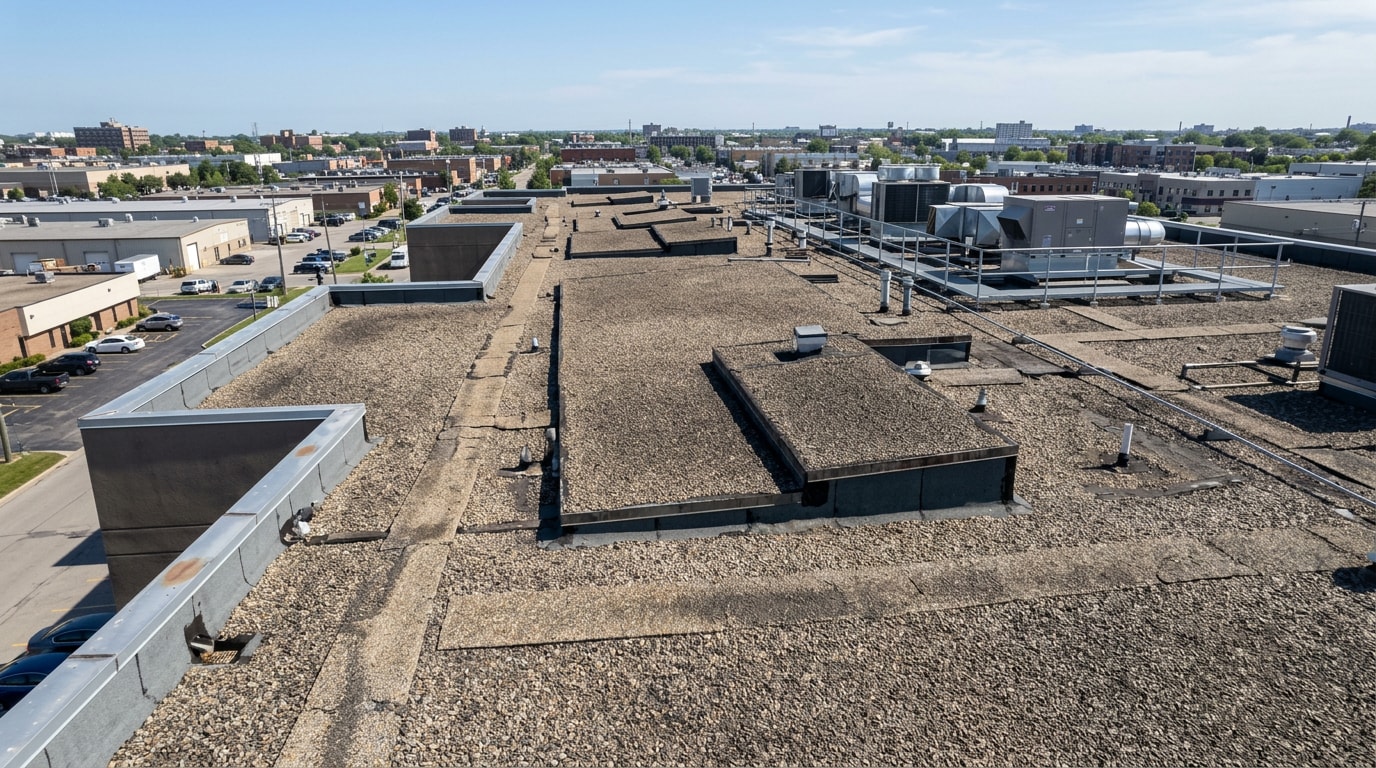
Built-up roofing (BUR) is a multi-ply flat roof system made from alternating layers of bitumen and reinforcing felt, finished with a gravel or mineral cap sheet. It's commonly called a tar and gravel roof, and it has covered commercial and industrial buildings for well over a century.
BUR is designed for commercial and low-slope applications, not the steep, pitched roofs found on most houses. If your building has a flat or gently sloped deck, it's a legitimate contender worth understanding in detail before you request bids.
What Built-Up Roofing Is Made Of
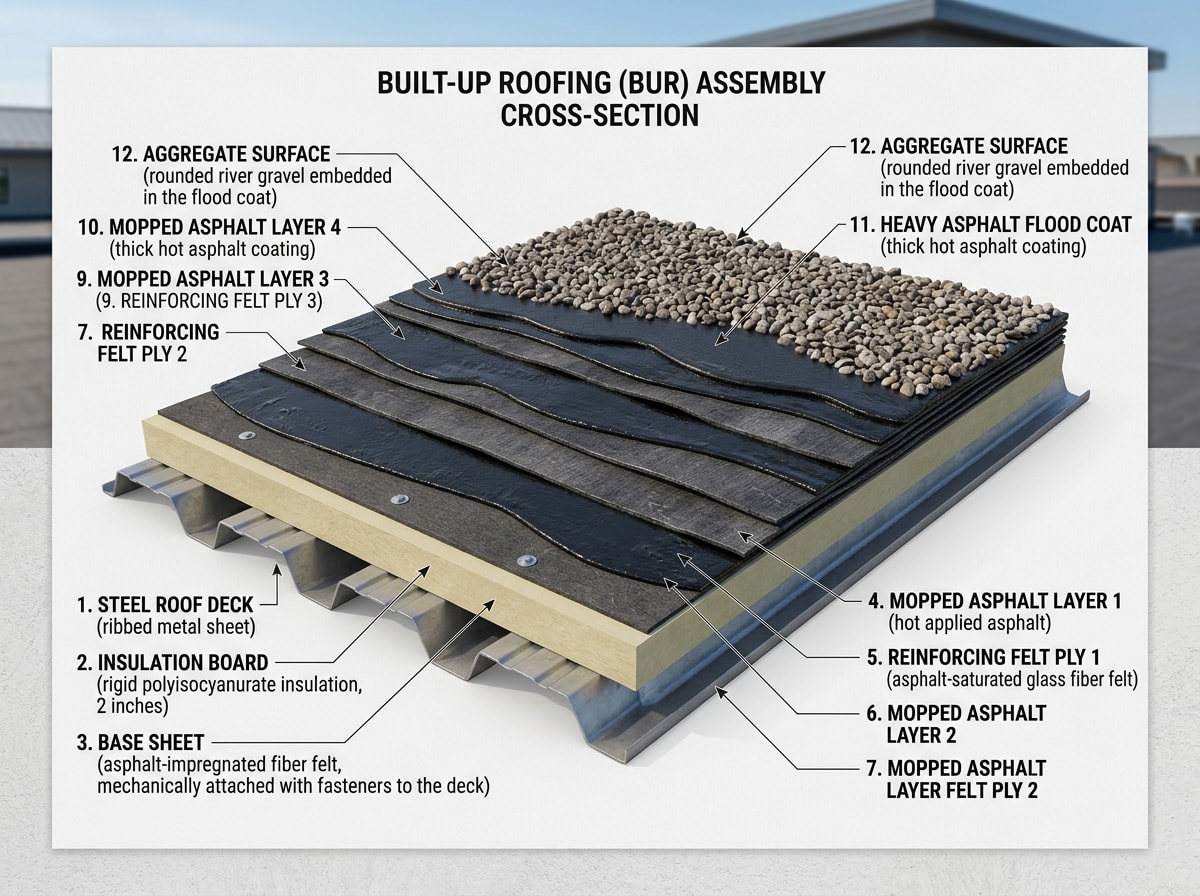
A standard BUR assembly starts with a base sheet anchored to the deck. Multiple ply sheets of reinforcing felt, saturated with bitumen, go on next. Each layer is embedded in hot or cold asphalt, and a gravel cap or mineral-surfaced sheet finishes the system. A typical 4-ply build runs a base sheet, four alternating layers of hot asphalt and reinforcing felt, a flood coat, and surfacing, with the finished assembly weighing 300 to 650 pounds per 100 square feet .
That weight matters in southern Idaho. Ground snow load varies dramatically across the state, running around 20 pounds per square foot in the Treasure Valley and far higher in mountainous regions . A heavy, gravel-ballasted BUR adds dead load on top of whatever snow load your deck already carries, so a structural check is worth doing before you commit to a gravel cap over a cold-applied cap sheet.
Pro tip: get the ply count specified in writing before signing a contract. More plies cost more upfront but generally add redundancy and service life. The NRCA's technical guidance on membrane roof system design is a solid reference if you want to understand the engineering before talking numbers with a contractor.
Built-Up Roofing Cost in Kuna, ID (2026)
BUR pricing swings more than most roofing types because it's field-assembled from several materials rather than rolled out as one membrane. National 2026 data shows a wide band: one commercial cost breakdown puts built-up roofing at $7.00 to $10.50 per square foot installed , while a broader flat-roof cost analysis shows built-up roof costs of $5.75 to $13.80 per square foot depending on ply count and access.
Labor is a major driver of that spread. BUR installation is more hands-on than rolling out a single-ply membrane, so a bigger share of the bid reflects crew time rather than material cost. Ply count, deck access, and whether an existing roof needs a full tear-off all factor into the final number.
What pushes your quote up or down:
- Ply count — 3-ply systems cost less than 4- or 5-ply builds but offer less redundancy
- Surfacing type — loose gravel ballast adds weight and cost versus a mineral cap sheet
- Tear-off scope — removing an old gravel-surfaced roof costs more than installing over a clean deck
- Deck access — crane or hoist access for materials and hot asphalt kettles adds labor hours
- Building size — larger roofs typically see a lower cost per square foot than small ones
Because of that range, the only reliable number is one based on a site visit. Request a free estimate to get pricing specific to your Kuna property.
Types of Built-Up Roofing Systems
BUR isn't installed one single way. The method changes how the layers bond and how long the project takes.
- Hot asphalt BUR — the traditional method. Base sheet goes down, then hot, mopped asphalt sets each layer of reinforcing felt in place.
- Cold-applied BUR — a newer approach using cold adhesive instead of hot-mopped asphalt, which can mean fewer jobsite safety concerns and less odor during install.
- Ballasted/gravel-surfaced BUR — finishes with a mineral-surfaced cap sheet or loose gravel ballast, adding weight, UV protection, and wind resistance.
Each method produces a similar finished roof but differs in labor, equipment, and install time — details worth discussing with your contractor before the project starts.
Is Built-Up Roofing a Good Fit for Your Building?
BUR tends to make the most sense for traditional multi-ply commercial assemblies rather than every flat-roof scenario. The honest answer depends on your structure's age, deck type, and how much roof traffic it sees.
Around Kuna and the broader Treasure Valley, BUR shows up most often on older commercial buildings, industrial structures, and properties that already have a built-up system and are due for a recover or repair. If your building falls into one of those categories, a roof inspection can confirm BUR as a straightforward option rather than a stretch fit.
Benefits of Built-Up Roofing
BUR has stayed in commercial use for decades for good reason. The multiple layers resist weather, UV exposure, and foot-traffic punctures that single-ply membranes can struggle with.
- Strong fire-resistant performance thanks to the gravel or mineral cap
- Solid UV protection, since the surfacing layer shields the bitumen plies from sun degradation
- Reliable waterproofing from redundant, overlapping layers
- Above-average puncture resistance compared to thinner single-ply systems
- A long track record across varied climates, including the hot, dry summers and freeze-thaw winters typical of southern Idaho
Drawbacks of BUR Systems
No roofing system is without trade-offs.
- Requires periodic maintenance to stay watertight
- Slower to install than single-ply alternatives like TPO or EPDM
- Added structural weight that matters if your deck wasn't designed for a heavy ballasted system
- Hot-asphalt installs bring odor and jobsite safety considerations that cold-applied systems avoid
Both the weight and install-time issues are worth raising with your contractor, and with a structural engineer if your deck is older or was built light.
Built-Up Roofing vs. Other Commercial Roofing Systems
Choosing between BUR and newer alternatives usually comes down to lifespan, upfront cost, and how the system performs under local weather. Modified bitumen is essentially an evolution of BUR-style construction with added flexibility. TPO, EPDM, and PVC are single-ply membranes that install faster but trade away some of BUR's layered redundancy for speed and lighter weight.
| System | Typical Cost Range (per sq ft) | Typical Lifespan | Treasure Valley Notes |
|---|---|---|---|
| Built-Up Roofing (BUR) | $5.75 – $13.80 | 20 – 30 years | Strong UV/heat resistance; added weight needs a deck check |
| Modified Bitumen | $4 – $8 | 15 – 20 years | Flexible in freeze-thaw cycles; faster install than BUR |
| TPO | $4 – $7 | 15 – 20 years | Reflective, helps with summer heat; seams need quality welds |
| EPDM | $3.50 – $8 | 15 – 25 years | Durable in temperature swings; less reflective than TPO |
| PVC | $5 – $8 | 15 – 25 years | Strong chemical/UV resistance; good for rooftop equipment areas |
Sources vary by region and specification, but the ranges above reflect EPDM at $3.50-6/sqft, TPO at $4-7/sqft, PVC at $5-8/sqft , with BUR and modified bitumen landing in similar territory depending on ply count and surfacing.
If EPDM looks like a better fit for your roof traffic or budget, our rubber roofing buyer's guide for Nampa breaks down that system in the same detail.
Reflective membranes like TPO and PVC can meaningfully cut cooling costs during hot Treasure Valley summers. The ENERGY STAR roof-products certification itself was phased out in 2022, but the Federal Energy Management Program still provides acquisition guidance for cool roof products using Cool Roof Rating Council test data if you want to dig into the numbers. For a closer look at which system fits your building, the Roofing Contractor page outlines what's offered locally.
Local Installation & Repair in Kuna, Idaho
Finding a crew that handles built-up roofing in Kuna, ID isn't always straightforward, since many contractors focus only on single-ply systems and shingles. Our crews at Bullseye Exteriors have torn off and recovered BUR roofs across the Treasure Valley, and the weight and ply-count questions above come straight from what we check on-site before quoting a job.

Browse our Kuna, ID area page to confirm coverage near your property before scheduling an inspection, or visit the homepage for a full look at our services.
Quality Roof Installation Process
A proper BUR installation starts with a thorough inspection of the existing roof structure and decking, followed by removal of old materials and surface preparation. From there, crews install underlayment and flashing to create a watertight barrier before beginning the ply layering, choosing hot or cold application and the right ply count for your building. Our Roof Installation team handles each of these stages in sequence rather than skipping steps to save time.
Permit requirements for low-slope commercial roofing vary by jurisdiction. Idaho's Division of Building Safety promotes health, safety, and welfare through administration of building safety laws in partnership with local jurisdictions , but most Kuna-area permits are actually pulled through the local city or county building department, so it's worth confirming the right office before work begins.
If your existing BUR roof has storm damage, hail bruising, or wind-lifted gravel rather than needing a full tear-off, our Storm Damage Repair and Roof Repair teams can usually patch the affected section instead.
FAQ
How long does a built-up roof last?
A well-built BUR system typically lasts 20 to 30 years, depending on ply count, maintenance history, and local climate exposure. Higher ply counts and regular upkeep push lifespan toward the higher end of that range.
How much does built-up roofing cost per square foot?
Expect roughly $5.75 to $13.80 per square foot installed in 2026, though exact pricing depends on ply count, surfacing choice, tear-off scope, and deck access. A site visit is the only way to get an accurate number for your building.
Is built-up roofing still used today?
Yes. While single-ply membranes now hold more market share, BUR remains a valid, code-compliant choice for many commercial and industrial buildings, especially where long-term durability and puncture resistance matter more than install speed.
Can a built-up roof be repaired?
Yes. Damaged sections of a BUR system can typically be patched without replacing the entire roof, which is one of its practical maintenance advantages over single-ply systems that are harder to spot-repair cleanly.
Does built-up roofing contain asbestos?
It can, in older installations. BUR systems installed before 1985 may contain asbestos in the reinforcing felts, interply asphalt, or flood coat, and any tear-off or disturbance of a pre-1985 system requires testing by a certified asbestos professional . If your building's roof predates 1985 and has never been tested, flag this before any tear-off work starts.
What is the best flat roof system for a commercial building?
It depends on your building's slope, drainage, insulation, rooftop equipment, budget, and exposure conditions. The comparison table earlier in this guide breaks down how BUR stacks up against TPO, EPDM, PVC, and modified bitumen on those exact factors.